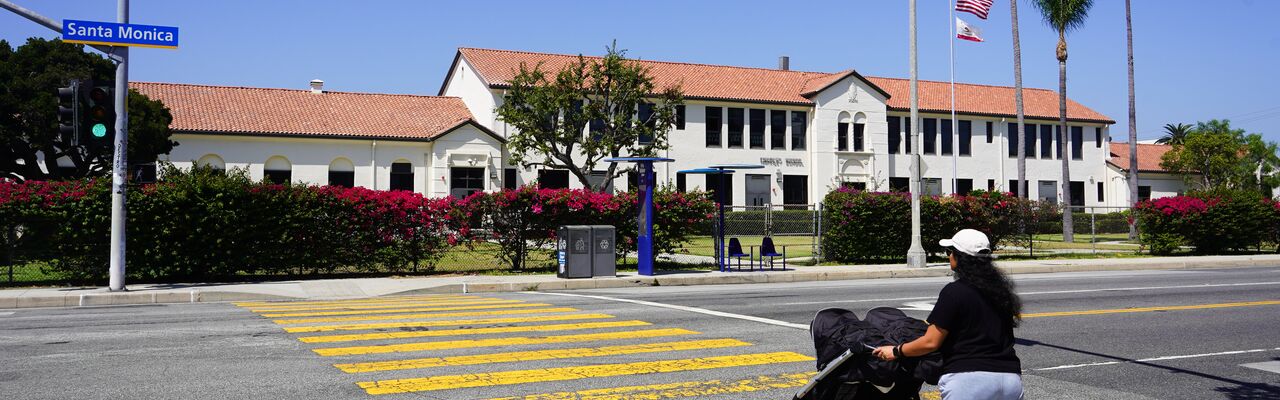
Santa Monica Boulevard Safety Project
As a result of prior studies, including the Vision Zero Action Plan and the Local Roadway Safety Plan, Santa Monica Boulevard emerged as a high-priority corridor where severe traffic-related injuries and one fatality have occurred over the past ten years. On May 12, 2026, the Santa Monica City Council adopted the Santa Monica Boulevard Safety Study to identify a cost-effective, high-impact approach to improving the corridor. The Study recommended a phased approach so that enhancements can be deployed quickly using available funding, tested and evaluated, and modified as needed before more permanent, capital-intensive measures are constructed.
The Santa Monica Boulevard Safety Project will implement the Study's recommended improvements in two phases.
Phase 1
Phase 1 improvements rely on local funding sources, are currently in design, and are planned for implementation before the 2028 Olympic and Paralympic Games. These improvements are coordinated with recommendations from the Westside Cities Council of Governments' Bus Connection Project, which aims to add a combination of peak-hour and full-time bus-only lanes along certain segments of Santa Monica Boulevard. Design will also be coordinated with the City's planned annual repaving of the corridor.
Phase 1 improvements include, but are not limited to:
- Quick-build turn restriction preventing left turns into and out of Chelsea Avenue from Santa Monica Boulevard — complete
- Repaving, signing, and striping of Santa Monica Boulevard from Ocean Avenue to Centinela Avenue
- Consistent pavement markings and signage
- Right-turn-only restrictions from side streets at unsignalized intersections
- Bicycle crossing improvements, such as bike detection and cross-bike markings that carry bike lanes through intersections
- New crosswalks (where adequate curb ramps are present)
- Pedestrian scrambles at 5th, 6th, and 7th Streets
- Rectangular Rapid Flashing Beacons (RRFBs)
- Updated crosswalk and roadway markings, including advance yield lines, paint-and-post curb extensions, daylighting, and lane narrowing (striping)
- Conversion of the number 2 travel lane to a full-time bus-only lane between 7th Street and 14th Street
- A peak-hour bus-only lane between Harvard Street and Centinela Avenue
Phase 2
In June 2026, the City submitted a California Department of Transportation (Caltrans) Active Transportation Program (ATP) grant application for the Phase 2 improvements. These improvements will move toward design and implementation if sufficient funding is secured. They would include:
- Hardened curb extensions at 6th Street, Lincoln Boulevard, 10th Street, 14th Street, 15th Street, 16th Street, 18th Street, 19th Street, and 26th Street
- Expanded bus stop improvements at Lincoln Boulevard, 14th Street, and 26th Street
- New crosswalks at 10th Street, 19th Street, Stanford Street, and Franklin Street
- A new pedestrian refuge and half traffic signal with crosswalk and bike crossing at Chelsea Avenue
- Landscaped pedestrian refuges at Princeton Street, Stanford Street, and Franklin Street
- New HAWK pedestrian signals at Franklin Street and Stanford Street
- Rectangular Rapid Flashing Beacons (RRFBs)
These improvements are designed to reduce the risk of crashes, improve pedestrian visibility, and create safer, more comfortable crossings for everyone traveling through and across Santa Monica Boulevard.